Grade 5 (CM2)
The final year before middle school: fractions, decimals, proportionality and full grammatical analysis. The goal: starting middle school with confidence.
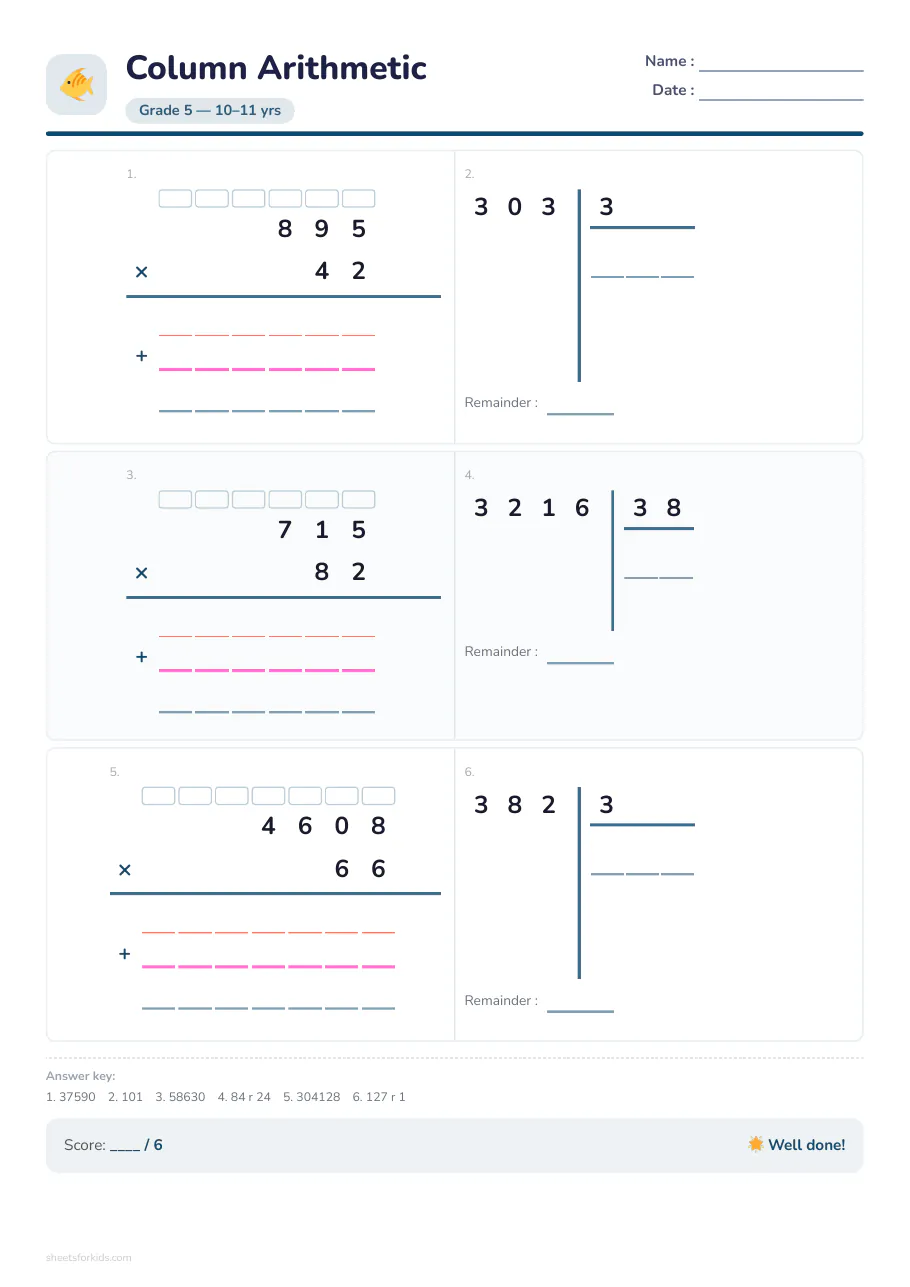
Sample worksheet
Long multiplication and division
Create this worksheetSeptember – December
Consolidating fractions and decimals
Skills to build
- Add and subtract fractions with the same denominator
- Compare and order decimal numbers
- Analyze word classes and their function in a sentence
- Conjugate in the imperfect and simple future tense
- Do mental math with simple decimal numbers
Recommended worksheets
One click opens the sheet: customize it, then print it as a PDF.
January – March
Proportionality and complex word problems
Skills to build
- Solve proportionality problems (simple rule of three)
- Calculate a simple percentage
- Solve multi-step word problems
- Master complex grammatical homophones
- Convert between units of measurement (length, mass, volume)
Recommended worksheets
One click opens the sheet: customize it, then print it as a PDF.
April – June
Getting ready for middle school
Skills to build
- Consolidate all times tables and calculation techniques
- Write a structured text with varied vocabulary
- Organize school work independently
- Solve comprehensive review problems (year-end summary)
- Start middle school with confidence
Recommended worksheets
One click opens the sheet: customize it, then print it as a PDF.
Go further
Frequently asked questions
How can I prepare my child for middle school (6e)?
Consolidate the basics used everywhere in middle school: fractions and decimals, proportionality, long division, conjugation and agreements. Train them to read long instructions and to organise themselves (timetable, school bag); the weekly planner on the site can help. A few regular minutes beat last-minute revision.
Which worksheets does the site offer for fifth grade (CM2)?
In math: fractions, decimals down to hundredths, proportionality (rule of three, percentages), column arithmetic including division by a two-digit number, measurements, geometry and word problems. In English: spelling, vocabulary (language registers) and reading comprehension; in French: conjugation (with the pluperfect and conditional) and grammar.
Does this curriculum match official school programs?
Yes, the term-by-term progression follows the broad outline of the French national curriculum and works as a useful benchmark for families anywhere. You can adapt the pace to your child's needs.
What if my child is ahead of or behind this curriculum?
This guide is a benchmark, not a requirement. If your child moves faster, feel free to check out the next level. If they need more time on a topic, revisit the previous term's worksheets without pressure.
Useful? Share it with other parents