Preschool Worksheets (Ages 3-4)
Free printables for kids ages 3-4 — pre-writing, shapes, name
All our free worksheets for preschoolers (ages 3-4). At this age, the goal isn't writing but pencil discovery, fine motor development, and recognition of shapes and first letters. Our tools offer pre-writing (lines, waves, loops), geometric shapes, simple logic sequences, and personalized name tracing. Each worksheet prints in under 30 seconds and is completely free. No pressure: 5-10 minutes a day is plenty at this age.
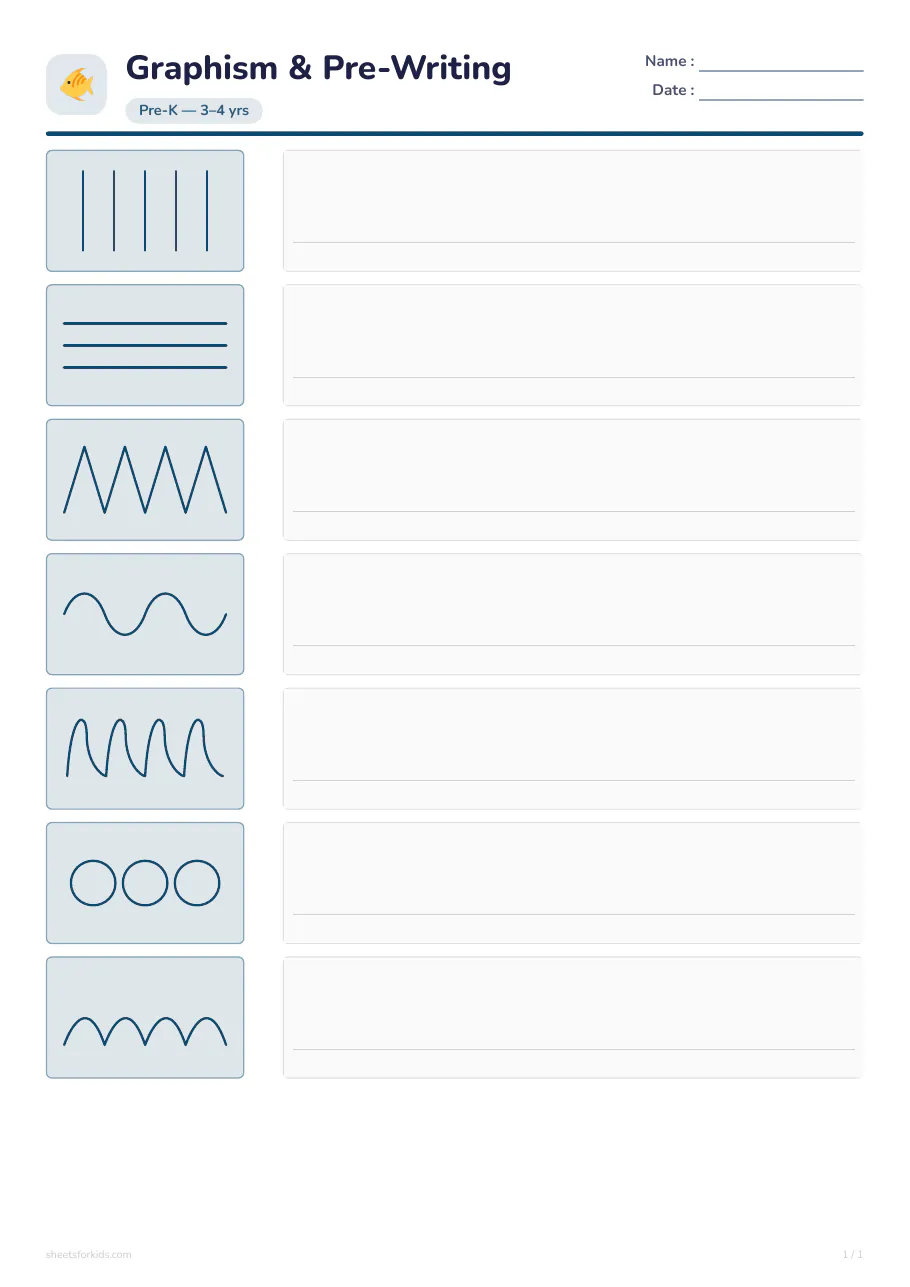
Sample worksheet
Graphism and pre-writing
A real worksheet generated by our tool: A4, ready to print and customizable (name, theme…).
Create this worksheetTools suited for ages 3-4
Pre-Writing & Graphomotor
Strokes, waves, zigzags, loops
Name Tracing
Learn to write your first name
Alphabet Tracing
Uppercase & lowercase with guides
Geometric Shapes (Pre-K–K)
Circle, square, triangle, rectangle
Counting Worksheets
Count objects: from 1–5 up to 50, by level
Pattern Sequences (Pre-K–3)
Complete shape and color sequences
Spatial Awareness (Pre-K–2)
Left/right, above/below, maps
Dot-to-Dot (Pre-K–3)
Connect the dots in order
Memory Cards to Cut
8–12 pairs to cut out
Bilingual Flashcards
Animals, fruits, colors in 2 languages
Morning & Evening Routine
Structure daily routines
Arabic Letter Tracing
28 Arabic letters with tracing guide
Custom Bingo
Animals, fruits, sports, transport
Color by Numbers
Match numbers to colors and paint
Chore Chart
Weekly grid with checkboxes
Custom Diploma
Customizable encouragement certificate
Preschool (PS) guide (Ages 3–4): the term-by-term curriculum
Pencil discovery, pre-writing and first letters. Main goal: make your child want to write through play.
What a 3-4 year old works on
At 3-4, kids develop pencil grip, hand-eye coordination, and focus. They learn to recognize colors, simple shapes (circle, square, triangle), count to 3-5 objects, orient themselves spatially (above, below, in front, behind), and trace first lines and curves. The first name starts being visually recognized and traced with help.
Parent tips for ages 3-4
Never force writing at this age. Children learn through play and imitation. Exercises should be short (5-10 min), positive (praise effort over result), and personalized (child's name on top, favorite theme). If your child isn't ready for an activity, wait a few weeks and try again — every child has their pace.
Common mistakes in preschool (ages 3-4) and how to avoid them
Asking for letters too early
At 3-4 the goal is not writing but getting the hand ready: lines, loops, circles and waves, drawn big. Letters come later, once the movement is secure.
Correcting the pencil grip too fast
The pinch grip between thumb and index finger builds up gradually. Offer chunky markers, play dough and clothespins to open and close: the hand gets stronger without your child feeling corrected.
Mixing up reciting and counting
A child can say "one, two, three" without touching an object for each word. Have them point at every object and move the ones already counted aside: that gesture is what gives the number its meaning.
Carrying on when your child switches off
Attention is short at this age. Stop at the first sign of tiredness, even halfway through a sheet, and pick it up tomorrow: five happy minutes beat twenty minutes of a standoff.
A typical week in preschool (ages 3-4)
Five sessions of 5-10 minutes, one a day, each with a tool from this page. Change the order to suit your child's mood.
- Monday — Pre-Writing & Graphomotor: Big loops and waves with a thick marker. Start by tracing the line with a finger, then move to a pencil.
- Tuesday — Name Tracing: Show the name, say each letter while following it with a finger, then let your child trace over the model.
- Wednesday — Geometric Shapes (Pre-K–K): Hunt for a circle, a square and a triangle around the house (plate, window, road sign), then find them on the sheet.
- Thursday — Counting Worksheets: Count real objects first (three spoons, four blocks), then do the sheet and point at every picture.
- Friday — Memory Cards to Cut: Cut out the cards and play together: turn over two cards, find the pair, say the name of the picture.
Frequently asked questions
Where should I start with a 3-4 year old?▾
Are they really free?▾
Can I customize the worksheets?▾
How do I know this level is right for my child?▾
How much time per day?▾
Are these aligned with curricula?▾
See also