Grade 3 Worksheets (Ages 8-9)
The consolidation year — free printables for Grade 3
All our free worksheets for Grade 3 (ages 8-9), the year consolidating Cycle 2 and preparing Grade 4. The curriculum expands: column multiplication, first divisions, measurement conversions, full conjugation (4 tenses), more complex agreements, advanced geometry. 25+ tools cover all these skills.
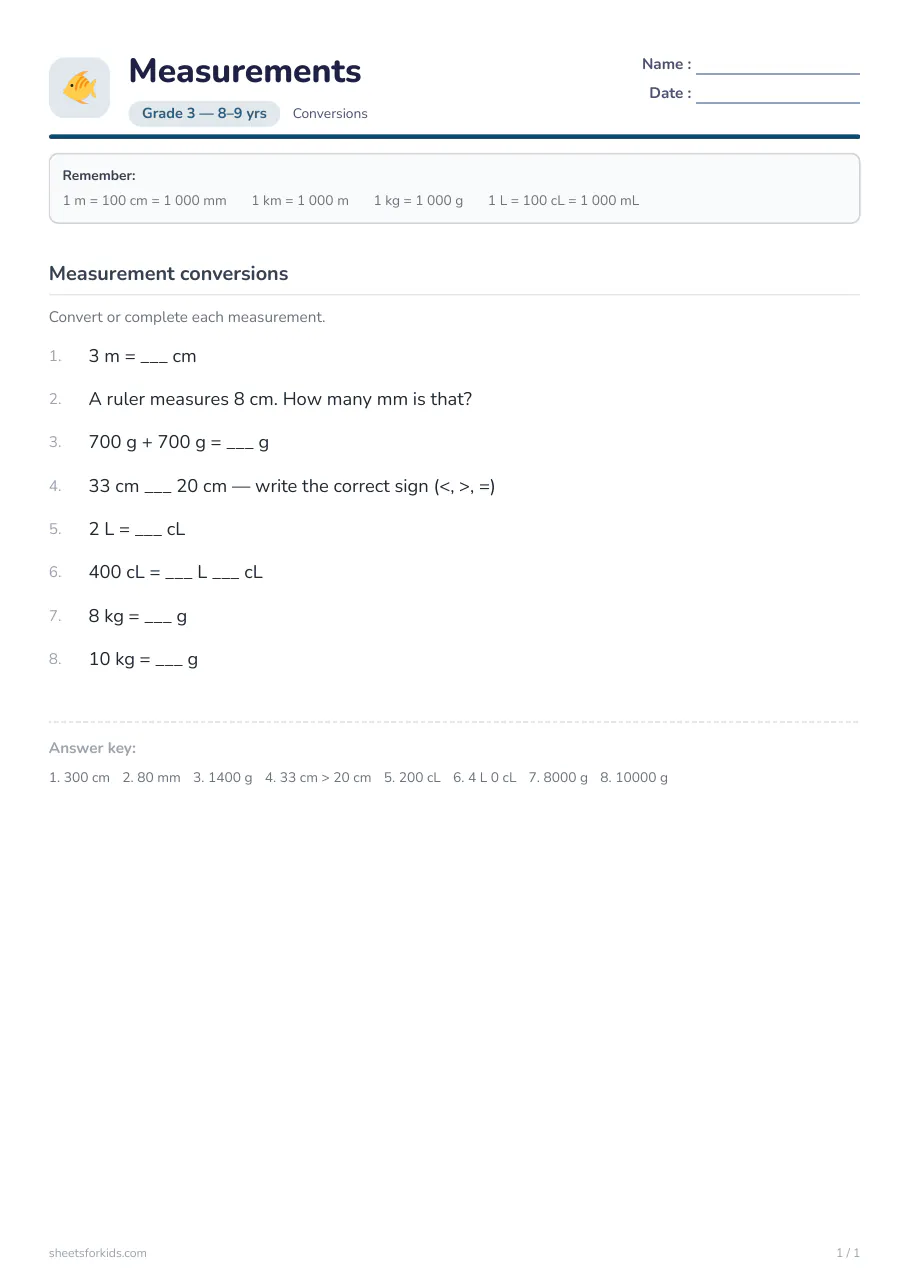
Sample worksheet
Measurement conversions
A real worksheet generated by our tool: A4, ready to print and customizable (name, theme…).
Create this worksheetTools suited for Grade 3
Mental Math (Grades 1–5)
Quick addition, subtraction, multiplication
Kids Sudoku (4×4 / 6×6)
Logic grids adapted for kids
Morning & Evening Routine
Structure daily routines
Reading Certificate
Reward reading progress with a personalised printable certificate
Phonics Worksheets
Recognize and match sounds
French Verb Conjugation
Conjugate verbs in present, past, future
French Grammar Worksheets
Nouns, verbs, agreements, word types
Spelling Worksheets
Confusing words, sight words, plurals
Vocabulary Worksheets
Synonyms, antonyms, word families, prefixes, figurative meaning
Syllable Workbook
Break words into syllables
Word Tracing
Copy words on guided lines
Bilingual Flashcards
Animals, fruits, colors in 2 languages
Arabic Letter Tracing
28 Arabic letters with tracing guide
Column Arithmetic (Grades 1–5)
Column addition, subtraction, multiplication and division
Math Word Problems (Grades 1–5)
Varied problem statements with calculation space
Reading Comprehension (Grades 1–5)
Short texts + MCQ + open question
Proportionality (Grades 4–5)
Tables, rule of three, percentages, scales
Decimal Numbers (Grades 4–5)
Read, compare, add, multiply by 10
Fractions (Grades 4–5)
Recognize, compare, add, simplify
Multiplication Tables (Grades 2–3)
Learn times tables 1 to 12
Number Sense (Grades 1–3)
Write, order, compare numbers
Geometry (Grades 1–5)
Symmetry, grids, perimeter and area, angles
Telling Time (Grades 1–3)
Hours, half hours, quarter hours
Pattern Sequences (Pre-K–3)
Complete shape and color sequences
Money (Euro) Grades 1–3
Recognize coins & bills, make change
Spatial Awareness (Pre-K–2)
Left/right, above/below, maps
Measurements (Grades 2–5)
Length, mass, capacity, time, area
Magic Coloring (Math)
Color by math result
Dot-to-Dot (Pre-K–3)
Connect the dots in order
Custom Bingo
Animals, fruits, sports, transport
Memory Cards to Cut
8–12 pairs to cut out
Color by Numbers
Match numbers to colors and paint
Weekly Planner
Organize the week activities
Chore Chart
Weekly grid with checkboxes
Custom Diploma
Customizable encouragement certificate
Grade 3 (CE2) guide (Ages 8–9): the term-by-term curriculum
Complete multiplication tables, introduction to division, and multi-digit arithmetic. A key level for building solid foundations before middle school.
Read the complete guide : Math Word Problems Grades 1-3
Word problems are where many elementary students struggle — not because they can't compute, but because they can't identify which … — 10 min read
What a Grade 3 student works on
Grade 3 consolidates everything: numbers to 10,000, column multiplication (1 then 2 digits), introduction to division, 2-step problems, measurement with conversions (cm/m, g/kg, L/mL), geometry (symmetry axes, right angles, polygons). In French: all simple tenses, grammatical analysis, lexical and grammatical spelling, vocabulary (word families, literal/figurative).
Parent tips for Grade 3
Grade 3 demands autonomy. At this age, kids can do homework alone if you teach them the method: read instructions carefully, draft if needed, check the answer. For multiplication, complete unmastered tables (×6, ×7, ×8, ×9). If reading is still laborious, it's still time to act — a speech therapist can help with persistent blocks.
Common mistakes in Grade 3 and how to avoid them
Not yet knowing the 6, 7, 8 and 9 times tables
These are the ones that cause trouble. Lean on what your child already knows: 7 × 8 = 5 × 8 + 2 × 8. The page for each table on the site shows this kind of breakdown.
Slipping up in long multiplication
When you multiply by the tens digit of the second number, the row has to move one place to the left (or start with a zero). Forgetting this gives an answer ten times too small.
Treating every verb as regular
Writing "goed" or "buyed" is a normal stage. Read the sentence aloud and ask "does that sound right?", then learn the irregular verbs in small groups.
Answering without reading the whole question
Two-step problems hide a middle question. Have your child underline the final question and write one sentence per step before calculating.
A typical week in Grade 3
Five sessions of 10-15 minutes, one a day, each with a tool from this page. Change the order to suit your child's mood.
- Monday — Multiplication Tables (Grades 2–3): Go back to the 6, 7, 8 and 9 tables only: one unknown fact at a time, found by breaking it down.
- Tuesday — Column Arithmetic (Grades 1–5): Long multiplication by one digit then by two digits, with the one-place shift clearly marked.
- Wednesday — Math Word Problems (Grades 1–5): Underline the question, list the facts, write one sentence per step, then calculate and check that the answer makes sense.
- Thursday — Spelling Worksheets: Practice a small group of tricky words, then write a short sentence using two of them.
- Friday — Vocabulary Worksheets: Look for words of the same family, synonyms and opposites, and use them in a sentence.
Frequently asked questions
Can my Grade 3 child do homework alone?▾
Are they really free?▾
Can I customize the worksheets?▾
How do I know this level is right for my child?▾
How much time per day?▾
Are these aligned with curricula?▾
See also