Grade 5 Worksheets (Ages 10-11)
Last year of elementary school — free printables for Grade 5
All our free worksheets for Grade 5 (ages 10-11), the last year of elementary school before middle school (6e). The goal is to consolidate Grade 4: fractions, decimal numbers (down to hundredths), proportionality with the rule of three and percentages, multi-step word problems and more complex texts. Our generators offer a Grade 5 level for fractions, decimal numbers, proportionality, column arithmetic (division by a two-digit number included), mental math, measurements, geometry, word problems, spelling, vocabulary and reading comprehension in English, and French conjugation and grammar. Free PDFs, customizable, ready to print in seconds.
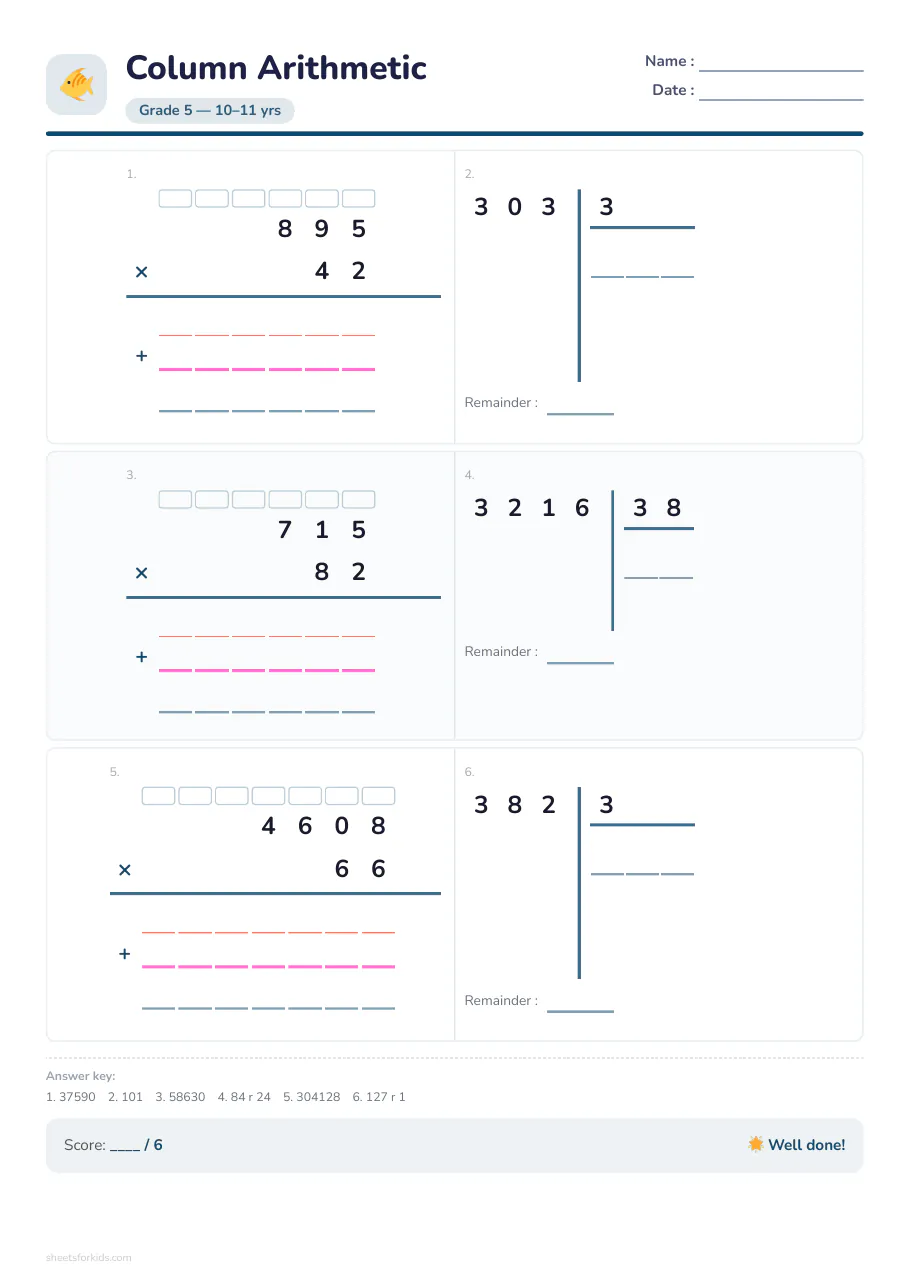
Sample worksheet
Long multiplication and division
A real worksheet generated by our tool: A4, ready to print and customizable (name, theme…).
Create this worksheetTools suited for Grade 5
Proportionality (Grades 4–5)
Tables, rule of three, percentages, scales
Decimal Numbers (Grades 4–5)
Read, compare, add, multiply by 10
Fractions (Grades 4–5)
Recognize, compare, add, simplify
Column Arithmetic (Grades 1–5)
Column addition, subtraction, multiplication and division
Number Sense (Grades 1–5)
Write, order, compare numbers
Time and Durations (Grades 1–5)
Hours, half hours, quarter hours
Mental Math (Grades 1–5)
Quick addition, subtraction, multiplication
Math Word Problems (Grades 1–5)
Varied problem statements with calculation space
Measurements (Grades 2–5)
Length, mass, capacity, time, area
Geometry (Grades 1–5)
Symmetry, grids, perimeter and area, angles
French Verb Conjugation
Conjugate verbs in present, past, future
French Grammar Worksheets
Nouns, verbs, agreements, word types
Spelling Worksheets
Confusing words, sight words, plurals
Vocabulary Worksheets
Synonyms, antonyms, word families, prefixes, figurative meaning
Reading Comprehension (Grades 1–5)
Short texts + MCQ + open question
Weekly Planner
Organize the week activities
Chore Chart
Weekly grid with checkboxes
Custom Diploma
Customizable encouragement certificate
Grade 5 (CM2) guide (Ages 10–11): the term-by-term curriculum
The final year before middle school: fractions, decimals, proportionality and full grammatical analysis. The goal: starting middle school with confidence.
Read the complete guide : Math Grade 4-5
Grades 4-5 are the most important bridge of elementary school to middle school. Fractions, decimal numbers, proportionality, compl… — 14 min read
What a Grade 5 student works on
Grade 5 closes Cycle 3 of elementary school and prepares for 6e. In math: very large numbers, column division, fractions (comparing, adding and subtracting with a common denominator), decimal numbers down to hundredths, proportionality (rule of three, simple percentages, scales), perimeter and area, multi-step problems. In English: spelling (affect/effect, accept/except, Latin and Greek plurals), vocabulary (word roots, language registers), writing structured texts and reading longer texts. In French: full grammatical analysis (word classes and functions), common tenses and past participle agreement.
Parent tips for Grade 5
Grade 5 is a pivotal year: the aim is to reach middle school with solid foundations and real independence. Prioritize what blocks (fractions, decimals, proportionality) rather than revising everything, and practice writing short texts and reading long instructions. Help your child get organized: weekly planner, school supplies, homework spread over several days — that is what changes most in middle school.
Common mistakes in Grade 5 and how to avoid them
Thinking that adding the same amount keeps things proportional
If 3 notebooks cost $6, then 6 notebooks cost $12, not $9. In proportionality you multiply both rows of the table by the same number; you do not add. A two-row table makes the multiplier visible.
Mixing up "10% of" and "plus 10"
10% of 80 is 80 divided by 10, which is 8; it is not 90. Remember that 10% is a tenth, 50% is a half and 25% is a quarter.
Confusing look-alike words
Affect and effect, accept and except: give each pair one memory hook. Affect is usually the action (a verb), effect is usually the result (a noun).
Skipping a step in a multi-step problem
List the facts, the final question and the middle question before calculating. Then reread the answer: does it make sense (a negative price, a 40-hour car trip)?
A typical week in Grade 5
Five sessions of 10-15 minutes, one a day, each with a tool from this page. Change the order to suit your child's mood.
- Monday — Proportionality (Grades 4–5): Complete a proportion table, find the multiplier, then solve a rule-of-three problem.
- Tuesday — Decimal Numbers (Grades 4–5): Calculate with decimals down to hundredths: adding, subtracting and multiplying by 10, 100 and 1,000.
- Wednesday — Fractions (Grades 4–5): Compare fractions, add them with a common denominator, and move from a fraction to a percentage.
- Thursday — Math Word Problems (Grades 1–5): One multi-step problem per session, with a drawing and a full-sentence answer.
- Friday — Spelling Worksheets: Practice pairs of look-alike words, then write sentences that show the difference.
Frequently asked questions
How can I prepare for middle school with these worksheets?▾
Are there French conjugation and grammar worksheets for Grade 5?▾
Are they really free?▾
Can I customize the worksheets?▾
How do I know this level is right for my child?▾
How much time per day?▾
Are these aligned with curricula?▾
See also