Grade 4 Worksheets (Ages 9-10)
First year of Cycle 3 — free printables for Grade 4
All our free worksheets for Grade 4 (ages 9-10), the first year of Cycle 3. The pace changes: fractions, decimal numbers, proportionality, multi-step word problems and longer texts to understand. Our generators offer a Grade 4 level for fractions, decimal numbers, proportionality, column arithmetic (multiplication and division included), mental math, measurements, geometry, word problems, spelling, vocabulary and reading comprehension in English, and French conjugation and grammar. Free PDFs, customizable, ready to print in seconds.
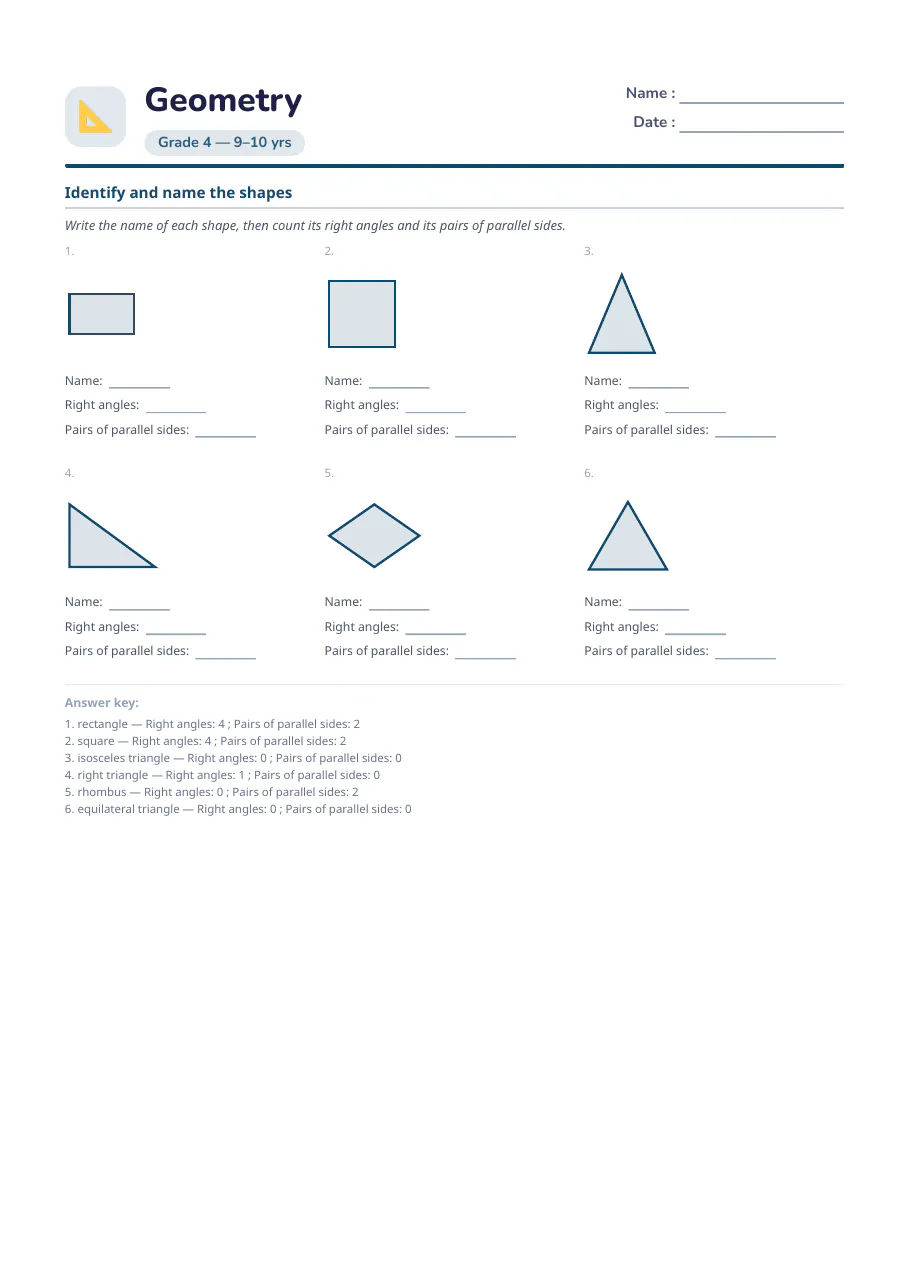
Sample worksheet
Geometry: shapes and angles
A real worksheet generated by our tool: A4, ready to print and customizable (name, theme…).
Create this worksheetTools suited for Grade 4
Fractions (Grades 4–5)
Recognize, compare, add, simplify
Column Arithmetic (Grades 1–5)
Column addition, subtraction, multiplication and division
Mental Math (Grades 1–5)
Quick addition, subtraction, multiplication
Number Sense (Grades 1–5)
Write, order, compare numbers
Time and Durations (Grades 1–5)
Hours, half hours, quarter hours
Decimal Numbers (Grades 4–5)
Read, compare, add, multiply by 10
Math Word Problems (Grades 1–5)
Varied problem statements with calculation space
Measurements (Grades 2–5)
Length, mass, capacity, time, area
Geometry (Grades 1–5)
Symmetry, grids, perimeter and area, angles
Proportionality (Grades 4–5)
Tables, rule of three, percentages, scales
French Verb Conjugation
Conjugate verbs in present, past, future
French Grammar Worksheets
Nouns, verbs, agreements, word types
Spelling Worksheets
Confusing words, sight words, plurals
Vocabulary Worksheets
Synonyms, antonyms, word families, prefixes, figurative meaning
Reading Comprehension (Grades 1–5)
Short texts + MCQ + open question
Weekly Planner
Organize the week activities
Chore Chart
Weekly grid with checkboxes
Custom Diploma
Customizable encouragement certificate
Grade 4 (CM1) guide (Ages 9–10): the term-by-term curriculum
Entry into upper elementary: large numbers, first fractions, decimal numbers and finer grammar analysis (word classes and functions). A pivotal level.
Read the complete guide : Math Grade 4-5
Grades 4-5 are the most important bridge of elementary school to middle school. Fractions, decimal numbers, proportionality, compl… — 14 min read
What a Grade 4 student works on
Grade 4 opens Cycle 3. In math: large numbers, column multiplication and division, fractions (introduced right from the start of the year in the 2025 curriculum), decimal numbers (tenths), first proportionality situations, perimeter, area and angles, multi-step problems. In English: spelling (weather/whether, brake/break, plural -ves), vocabulary (word families, prefixes, suffixes, opposites) and reading longer texts. In French: word classes and functions (subject, complements), simple tenses and the passé composé, agreements within the noun phrase.
Parent tips for Grade 4
In Grade 4 the concepts become abstract: fractions, decimals, sentence grammar. Start with concrete examples (sharing a pizza, reading a price with a decimal point), then move on to worksheets. Ask your child to explain their method out loud: it is the best comprehension test. Aim for short, regular sessions (15-20 minutes) and check that multiplication tables are automatic — they are used everywhere in Cycle 3.
Common mistakes in Grade 4 and how to avoid them
Adding the numerators and the denominators
1/4 + 1/4 is not 2/8 but 2/4. The denominator says how many equal parts the whole is cut into: it does not change when you add parts of the same size. A drawing (a bar cut into parts) makes the mistake visible.
Comparing decimals like whole numbers
3.12 and 3.4: many children think 3.12 is larger because 12 > 4. Compare the tenths first, using a place-value chart or prices ($3.40 and $3.12).
Mixing up perimeter and area
Perimeter is a length (in cm), area is a surface (in cm²). Have your child trace the outline in red and shade the inside: the two ideas are then easy to tell apart.
Getting lost in long division
A forgotten zero in the quotient shifts the whole answer. Always check by multiplying the quotient by the divisor, then adding the remainder.
A typical week in Grade 4
Five sessions of 10-15 minutes, one a day, each with a tool from this page. Change the order to suit your child's mood.
- Monday — Fractions (Grades 4–5): Colour fractions on bars, compare two fractions with the same denominator, then add them.
- Tuesday — Decimal Numbers (Grades 4–5): Place decimals on a number line and compare them starting with the tenths.
- Wednesday — Column Arithmetic (Grades 1–5): One long division per session, with the check: quotient × divisor + remainder.
- Thursday — Math Word Problems (Grades 1–5): Multi-step problems: list the facts, write the middle question, then calculate.
- Friday — Spelling Worksheets: Look-alike words one pair at a time, with a short sentence for each.
Frequently asked questions
What if my Grade 4 child is falling behind in math?▾
Are there French conjugation and grammar worksheets for Grade 4?▾
Are they really free?▾
Can I customize the worksheets?▾
How do I know this level is right for my child?▾
How much time per day?▾
Are these aligned with curricula?▾
See also