Pre-K Worksheets (Ages 4-5)
Free printables for kids ages 4-5 — alphabet, name, shapes
All our free worksheets for Pre-K (ages 4-5). At this age, kids consolidate their handwriting gesture, start recognizing uppercase letters, and learn to write their name. Our tools offer advanced pre-writing, uppercase alphabet tracing, geometric shapes, logical sequences, and time orientation (days, months). Each PDF is free, customizable, and print-ready in seconds.
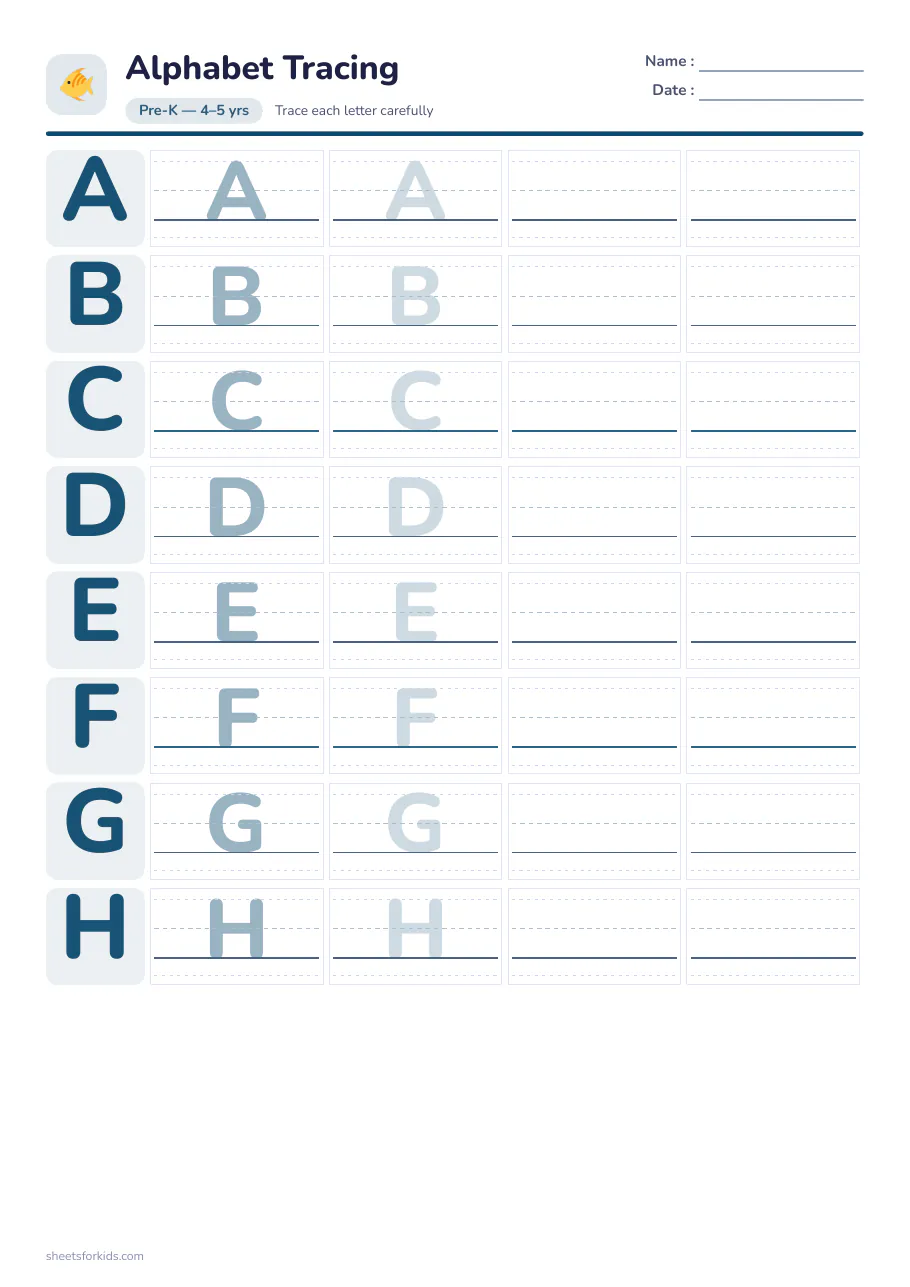
Sample worksheet
Alphabet tracing
A real worksheet generated by our tool: A4, ready to print and customizable (name, theme…).
Create this worksheetTools suited for ages 4-5
Alphabet Tracing
Uppercase & lowercase with guides
Name Tracing
Learn to write your first name
Counting Worksheets
Count objects: from 1–5 up to 50, by level
Kids Sudoku (4×4 / 6×6)
Logic grids adapted for kids
Morning & Evening Routine
Structure daily routines
Reading Certificate
Reward reading progress with a personalised printable certificate
Phonics Worksheets
Recognize and match sounds
Syllable Workbook
Break words into syllables
Time Orientation
Days, months, seasons, calendar
Number Tracing 0–9
Write digits with counting dots
Pre-Writing & Graphomotor
Strokes, waves, zigzags, loops
Word Tracing
Copy words on guided lines
Bilingual Flashcards
Animals, fruits, colors in 2 languages
Arabic Letter Tracing
28 Arabic letters with tracing guide
Geometric Shapes (Pre-K–K)
Circle, square, triangle, rectangle
Pattern Sequences (Pre-K–3)
Complete shape and color sequences
Spatial Awareness (Pre-K–2)
Left/right, above/below, maps
Magic Coloring (Math)
Color by math result
Dot-to-Dot (Pre-K–3)
Connect the dots in order
Custom Bingo
Animals, fruits, sports, transport
Memory Cards to Cut
8–12 pairs to cut out
Color by Numbers
Match numbers to colors and paint
Weekly Planner
Organize the week activities
Chore Chart
Weekly grid with checkboxes
Custom Diploma
Customizable encouragement certificate
Pre-K (MS) guide (Ages 4–5): the term-by-term curriculum
Consolidating letter formation, introducing lowercase letters and early numeracy. A pivotal year for graphic independence.
What a 4-5 year old works on
At 4-5, kids refine fine motor skills, recognize and trace uppercase print letters, write their name alone, count to 10, order numbers, identify days of the week and seasons. They develop vocabulary, phonological awareness, and structured spatial-temporal orientation.
Parent tips for ages 4-5
At this age, your child can focus 10-15 minutes on a directed activity. Prefer short and varied worksheets over long sessions. Name tracing is the key activity — repeating the name anchors identity and is highly motivating. Uppercase print is more accessible than cursive at this age.
Common mistakes in Pre-K (ages 4-5) and how to avoid them
Moving to joined-up writing too soon
At 4-5, capital letters are the easiest to form: straight lines and circles, no joins. Joined handwriting can wait.
Ignoring the direction of the stroke
A letter is always started from the same point and drawn in the same direction. A habit picked up the wrong way (an "o" drawn clockwise) is hard to undo later. Have your child say it aloud: "I start at the top and turn to the left."
Mixing up a letter's name and its sound
The letter m is called "em", but it says /m/ in "mom". Play with sounds and syllables (clapping "mom-my") before insisting on letter names.
Reciting numbers without counting a quantity
Being able to say the numbers up to ten is not the same as knowing how many counters there are. After each count, ask "how many are there?" and have your child answer with the last number said.
A typical week in Pre-K (ages 4-5)
Five sessions of 10-15 minutes, one a day, each with a tool from this page. Change the order to suit your child's mood.
- Monday — Name Tracing: Trace the name in capital letters, always starting from the same point, then copy it alone under the model.
- Tuesday — Phonics Worksheets: Clap the syllables of family members' names, then look for words that start with the same sound.
- Wednesday — Counting Worksheets: Count up to ten objects lined up, then jumbled, and say how many there are in total.
- Thursday — Pre-Writing & Graphomotor: Copy bridges, waves and loops on the line, putting the pencil down at the top of the page.
- Friday — Time Orientation: Say the days of the week in order, find today and the current season, then complete the sheet.
Frequently asked questions
What should be the priority at ages 4-5?▾
Are they really free?▾
Can I customize the worksheets?▾
How do I know this level is right for my child?▾
How much time per day?▾
Are these aligned with curricula?▾
See also