Grade 2 Worksheets (Ages 7-8)
The year of fluency — free printables for Grade 2
All our free worksheets for Grade 2 (ages 7-8), when automaticity sets in: multiplication tables, multi-tense conjugation, regrouping, reading time to the minute. 25+ tools cover math (number sense, column arithmetic with regrouping, tables, measurements, geometry, money), language (spelling, vocabulary, plurals) and French (conjugation, grammar). Free, customizable, instantly printable.
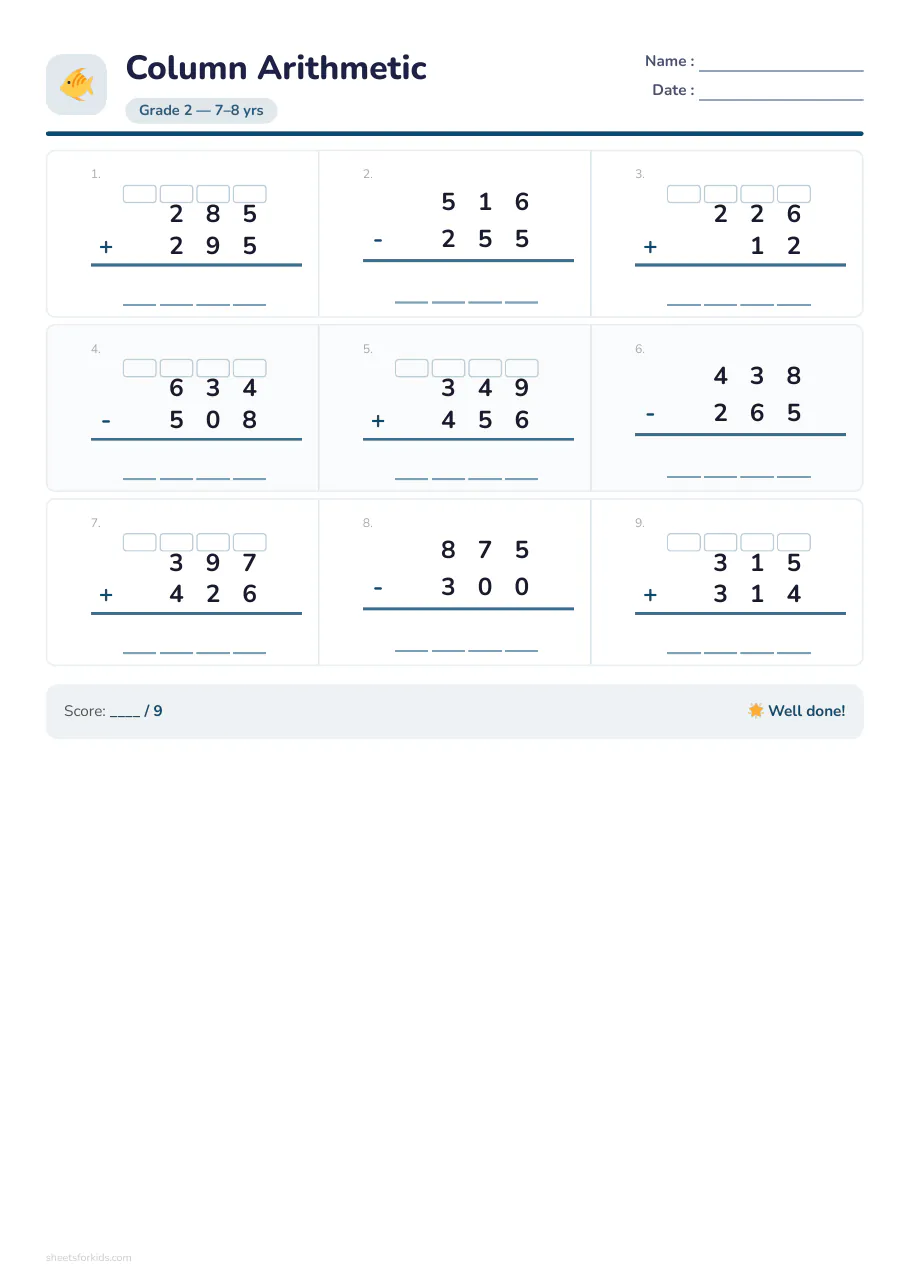
Sample worksheet
Column arithmetic
A real worksheet generated by our tool: A4, ready to print and customizable (name, theme…).
Create this worksheetTools suited for Grade 2
Alphabet Tracing
Uppercase & lowercase with guides
Mental Math (Grades 1–5)
Quick addition, subtraction, multiplication
Counting Worksheets
Count objects: from 1–5 up to 50, by level
Kids Sudoku (4×4 / 6×6)
Logic grids adapted for kids
Morning & Evening Routine
Structure daily routines
Reading Certificate
Reward reading progress with a personalised printable certificate
Phonics Worksheets
Recognize and match sounds
French Verb Conjugation
Conjugate verbs in present, past, future
French Grammar Worksheets
Nouns, verbs, agreements, word types
Spelling Worksheets
Confusing words, sight words, plurals
Vocabulary Worksheets
Synonyms, antonyms, word families, prefixes, figurative meaning
Syllable Workbook
Break words into syllables
Time Orientation
Days, months, seasons, calendar
Number Tracing 0–9
Write digits with counting dots
Word Tracing
Copy words on guided lines
Bilingual Flashcards
Animals, fruits, colors in 2 languages
Arabic Letter Tracing
28 Arabic letters with tracing guide
Column Arithmetic (Grades 1–5)
Column addition, subtraction, multiplication and division
Math Word Problems (Grades 1–5)
Varied problem statements with calculation space
Reading Comprehension (Grades 1–5)
Short texts + MCQ + open question
Multiplication Tables (Grades 2–3)
Learn times tables 1 to 12
Number Sense (Grades 1–3)
Write, order, compare numbers
Geometry (Grades 1–5)
Symmetry, grids, perimeter and area, angles
Telling Time (Grades 1–3)
Hours, half hours, quarter hours
Pattern Sequences (Pre-K–3)
Complete shape and color sequences
Money (Euro) Grades 1–3
Recognize coins & bills, make change
Spatial Awareness (Pre-K–2)
Left/right, above/below, maps
Measurements (Grades 2–5)
Length, mass, capacity, time, area
Magic Coloring (Math)
Color by math result
Dot-to-Dot (Pre-K–3)
Connect the dots in order
Custom Bingo
Animals, fruits, sports, transport
Memory Cards to Cut
8–12 pairs to cut out
Color by Numbers
Match numbers to colors and paint
Weekly Planner
Organize the week activities
Chore Chart
Weekly grid with checkboxes
Custom Diploma
Customizable encouragement certificate
Grade 2 (CE1) guide (Ages 7–8): the term-by-term curriculum
Introduction to multiplication tables and deepening reading skills. Daily mental math worksheets are essential for building automaticity.
Read the complete guide : End of Grade 2 Review 2026
Grade 2 introduces the hardest operation most kids have seen so far (subtraction with regrouping), fluency expectations for all ad… — 11 min read
What a Grade 2 student works on
Grade 2 consolidates reading (fluency, comprehension) and establishes math automaticity. Math: number sense to 1000, addition/subtraction with regrouping, multiplication tables (×2, ×3, ×5, ×10 first), problem solving, length measurements, money. English: spelling (to/too/two, see/sea, plural -s/-es/-ies) and the right verb form (she runs, they run). French: present/imperfect/future/past tense conjugation and word types (noun, verb, adjective).
Parent tips for Grade 2
The stakes in Grade 2 are AUTOMATICITY. Multiplication tables must be memorized (×2, ×5, ×10 first, then ×3, ×4). 5 minutes daily of recitation beats 30 minutes once a week. For reading, ask your child to retell what they read — comprehension over speed. Spelling builds through short dictations and careful copying.
Common mistakes in Grade 2 and how to avoid them
Learning the times tables only in order
Reciting 2 × 1, 2 × 2, 2 × 3 is not enough: your child also needs to find 2 × 7 without starting from zero. Mix up the order, ask both ways round (3 × 5 and 5 × 3) and revise a little, but every day.
Forgetting to carry, or lining up columns badly
In a column addition, ones go under ones and tens under tens. Squared paper helps, and the carried digit is always written in the same place, small.
Mixing up common homophones
Their and there, to and too, your and you're: "there" is a place (here and there), "their" belongs to them, "you're" is "you are". Have your child say the full phrase to check.
Reading fast without understanding
After each paragraph, ask your child to retell it in their own words. If they cannot, reread together: understanding comes before speed.
A typical week in Grade 2
Five sessions of 10-15 minutes, one a day, each with a tool from this page. Change the order to suit your child's mood.
- Monday — Multiplication Tables (Grades 2–3): One table at a time (2, 5 and 10 first), then questions in random order and both ways round.
- Tuesday — Column Arithmetic (Grades 1–5): Set out a few additions and subtractions with the columns lined up, and check every carried digit.
- Wednesday — Spelling Worksheets: A small group of words at a time: read, cover, write from memory, compare with the model.
- Thursday — Vocabulary Worksheets: Sort words into groups, find opposites and words that go together, and use two of them in a sentence.
- Friday — Telling Time (Grades 1–3): Read the real clock at home on the hour and half hour, then do the sheet.
Frequently asked questions
Does my child need to know all the times tables in Grade 2?▾
Are they really free?▾
Can I customize the worksheets?▾
How do I know this level is right for my child?▾
How much time per day?▾
Are these aligned with curricula?▾
See also