Grade 1 Worksheets (Ages 6-7)
The year of reading and calculation — free printables for Grade 1
All our free worksheets for Grade 1 (ages 6-7), the year kids learn to read and calculate. Over 25 tools cover the curriculum: syllables and phonics for reading, alphabet and word copying for writing, column arithmetic and number sense for math, plus spelling, French conjugation, geometry, measurements, money, and telling time. Each PDF is free, customizable, and print-ready.
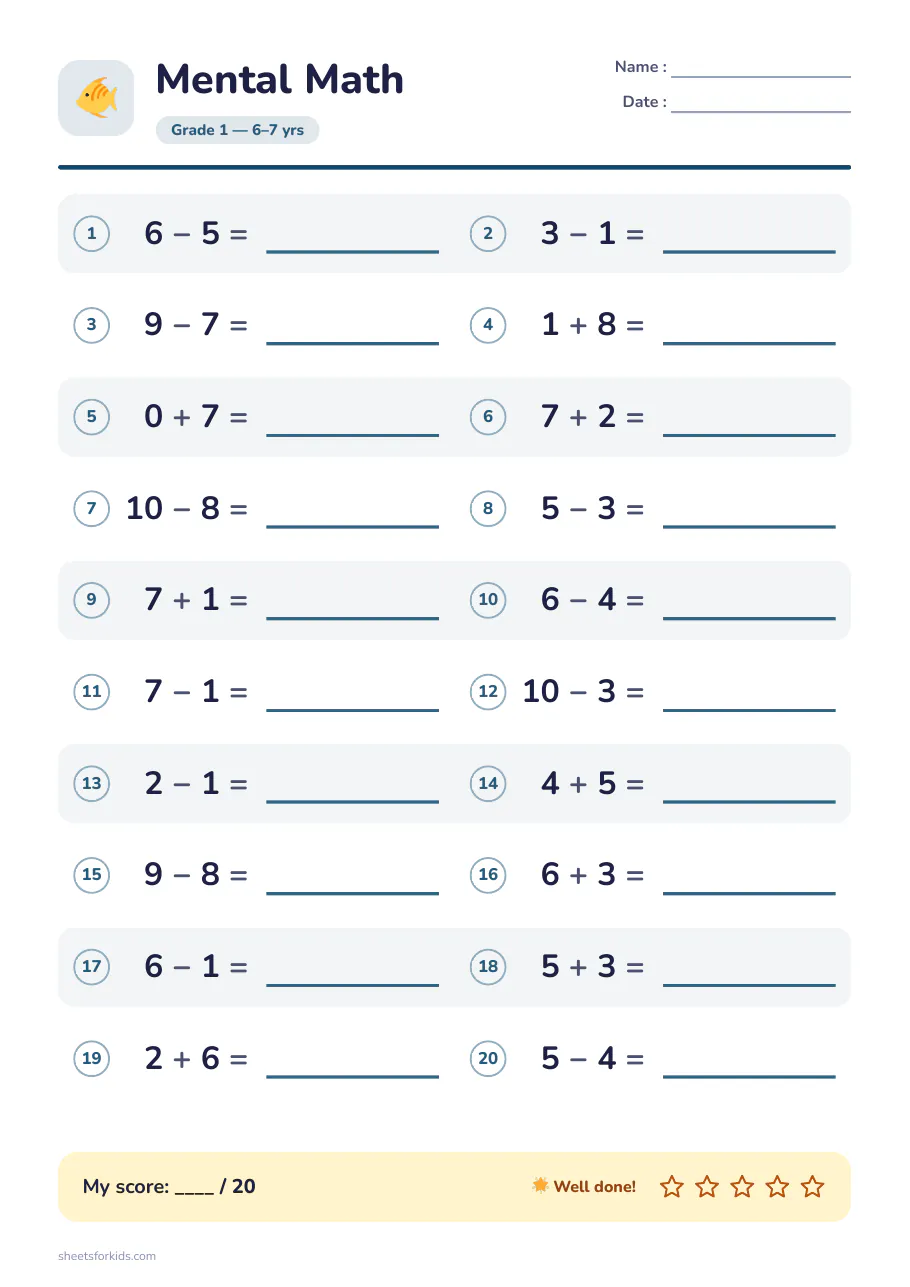
Sample worksheet
Mental math
A real worksheet generated by our tool: A4, ready to print and customizable (name, theme…).
Create this worksheetTools suited for Grade 1
Alphabet Tracing
Uppercase & lowercase with guides
Name Tracing
Learn to write your first name
Mental Math (Grades 1–5)
Quick addition, subtraction, multiplication
Counting Worksheets
Count objects: from 1–5 up to 50, by level
Kids Sudoku (4×4 / 6×6)
Logic grids adapted for kids
Morning & Evening Routine
Structure daily routines
Reading Certificate
Reward reading progress with a personalised printable certificate
Phonics Worksheets
Recognize and match sounds
French Verb Conjugation
Conjugate verbs in present, past, future
French Grammar Worksheets
Nouns, verbs, agreements, word types
Spelling Worksheets
Confusing words, sight words, plurals
Vocabulary Worksheets
Synonyms, antonyms, word families, prefixes, figurative meaning
Syllable Workbook
Break words into syllables
Time Orientation
Days, months, seasons, calendar
Number Tracing 0–9
Write digits with counting dots
Word Tracing
Copy words on guided lines
Bilingual Flashcards
Animals, fruits, colors in 2 languages
Arabic Letter Tracing
28 Arabic letters with tracing guide
Column Arithmetic (Grades 1–5)
Column addition, subtraction, multiplication and division
Math Word Problems (Grades 1–5)
Varied problem statements with calculation space
Reading Comprehension (Grades 1–5)
Short texts + MCQ + open question
Multiplication Tables (Grades 2–3)
Learn times tables 1 to 12
Number Sense (Grades 1–3)
Write, order, compare numbers
Geometric Shapes (Pre-K–K)
Circle, square, triangle, rectangle
Geometry (Grades 1–5)
Symmetry, grids, perimeter and area, angles
Telling Time (Grades 1–3)
Hours, half hours, quarter hours
Pattern Sequences (Pre-K–3)
Complete shape and color sequences
Money (Euro) Grades 1–3
Recognize coins & bills, make change
Spatial Awareness (Pre-K–2)
Left/right, above/below, maps
Measurements (Grades 2–5)
Length, mass, capacity, time, area
Magic Coloring (Math)
Color by math result
Dot-to-Dot (Pre-K–3)
Connect the dots in order
Custom Bingo
Animals, fruits, sports, transport
Memory Cards to Cut
8–12 pairs to cut out
Color by Numbers
Match numbers to colors and paint
Weekly Planner
Organize the week activities
Chore Chart
Weekly grid with checkboxes
Custom Diploma
Customizable encouragement certificate
Grade 1 (CP) guide (Ages 6–7): the term-by-term curriculum
The most important year: learning to read and first math operations. Regular support at home makes a real difference.
Read the complete guide : Sight Words Grade 1
By the end of Grade 1, your child should recognize about 100-130 sight words instantly — without sounding them out. These are the … — 9 min read
What a Grade 1 student works on
Grade 1 is the year of major milestones. Reading: blending (b+a=ba), complex syllables, sight words. Writing: lowercase cursive, copying sentences. Math: number sense to 100, column addition/subtraction without carrying, multiplication concept, first measurements, telling time on the hour. Plus grammar (subject/verb), conjugation (present), spelling (sight words, simple agreements).
Parent tips for Grade 1
Grade 1 demands patience and consistency. If reading is hard, work on SYLLABLES daily (5-10 min) — it's the key. For math, manipulate before writing: use concrete objects to understand addition before worksheets. Avoid comparison with other kids: every child decodes at their own pace between 6 and 8, and that's no sign of intelligence.
Common mistakes in Grade 1 and how to avoid them
Guessing words instead of decoding them
Many children guess from the picture or the first letter. Ask for the word to be read syllable by syllable, then reread the whole sentence: fluent reading is built on solid decoding.
Confusing similar sounds
b and d, p and q, sh and ch, m and n: work on one pair at a time, first by ear and then in print, rather than rereading everything.
Counting without understanding tens and ones
34 is 3 tens and 4 ones. Have your child bundle sticks or counters into tens before setting out an addition: without that idea, the calculations that follow stay mechanical.
Writing fast at the expense of shape
In Grade 1, one well-formed letter (starting point, direction, height) is worth ten rushed ones. A few careful lines a day are enough.
A typical week in Grade 1
Five sessions of 10-15 minutes, one a day, each with a tool from this page. Change the order to suit your child's mood.
- Monday — Syllable Workbook: Read syllables, then words, aloud, one line at a time, and reread the whole sentence.
- Tuesday — Phonics Worksheets: Listen for one specific sound in words, then write it under the right picture.
- Wednesday — Number Sense (Grades 1–3): Make tens with objects, write the number you get, then compare two numbers.
- Thursday — Mental Math (Grades 1–5): A few simple additions out loud, with fingers or counters at first, then without help.
- Friday — Spelling Worksheets: Copy a few common words, then cover them and write them from memory, taking care over letter shapes.
Frequently asked questions
My Grade 1 child reads slowly: should I worry?▾
Are they really free?▾
Can I customize the worksheets?▾
How do I know this level is right for my child?▾
How much time per day?▾
Are these aligned with curricula?▾
See also