Kindergarten (GS)
The year of getting ready for Grade 1. Full alphabet, fluent name writing, and first arithmetic. Your child should enter Grade 1 with solid writing foundations.
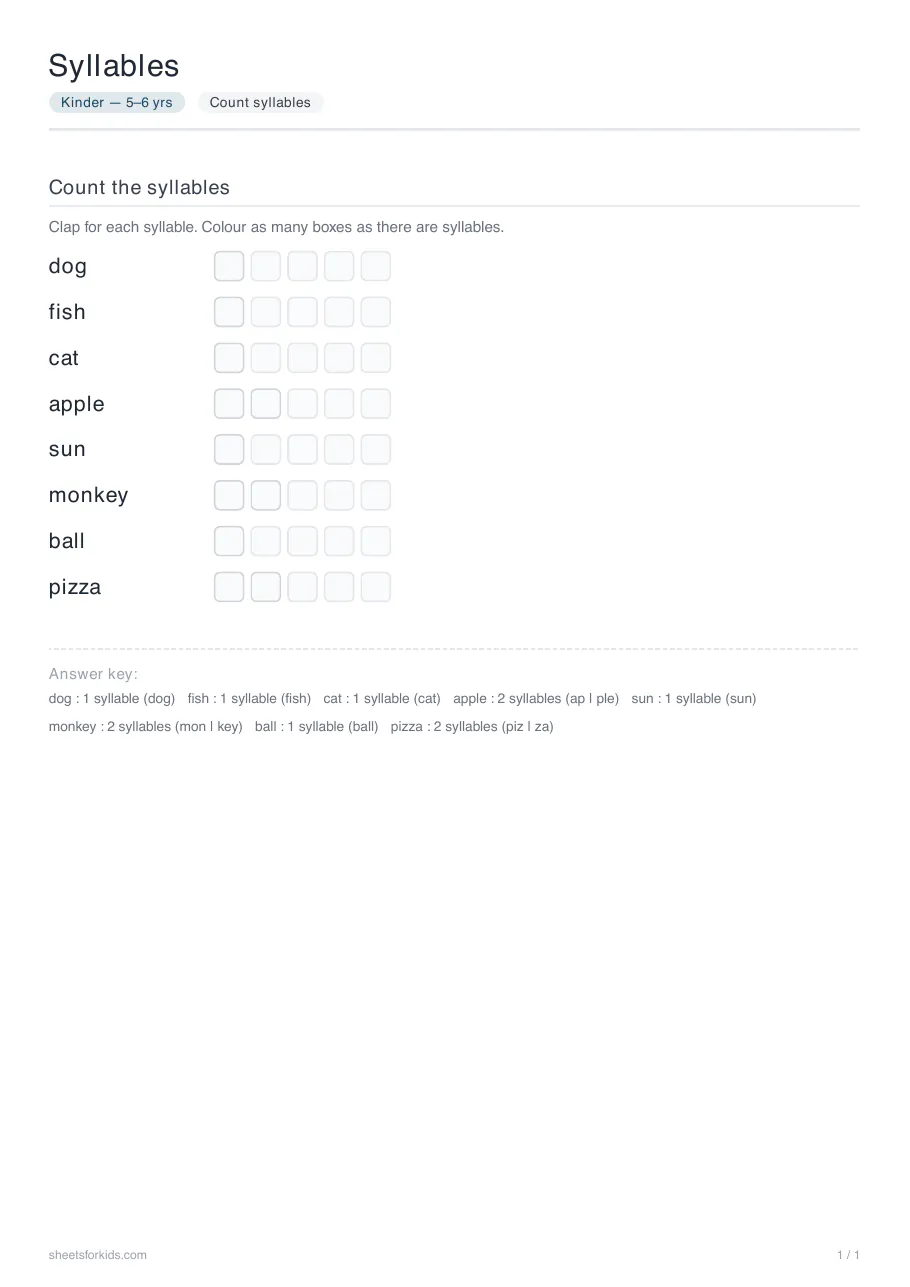
Sample worksheet
Counting syllables
Create this worksheetSeptember – December
Full alphabet & fluent writing
Skills to build
- Trace full alphabet uppercase and lowercase
- Write their name fluently in uppercase
- Count and recognize numbers up to 10
- Trace digits 0-9 with correct strokes
- Solve age-appropriate logic games (4×4 sudoku)
Recommended worksheets
One click opens the sheet: customize it, then print it as a PDF.
January – March
Phonics & first words
Skills to build
- Match sounds to letters (phonics)
- Identify the initial sound of a word
- Write syllables and simple words (ma, pa, la)
- Intuitively calculate up to 10 (add/remove 1)
- Trace digits 0-9 with correct writing direction
- Identify rhymes and syllables in a word
Recommended worksheets
One click opens the sheet: customize it, then print it as a PDF.
April – June
Grade 1 preparation & autonomy
Skills to build
- Cursive writing of first letters (a, e, i, o, u)
- Simple addition and subtraction up to 10 (+1, -1)
- Manage daily routine independently
- Read and write their name in cursive
- Organize the week with a visual planner
- Complete simple household tasks independently
Recommended worksheets
One click opens the sheet: customize it, then print it as a PDF.
Frequently asked questions
Does my child need to read before starting first grade (CP)?
No, reading is taught in first grade. In the last preschool year the goal is to arrive with the basics: recognising letters, splitting words into syllables, hearing sounds, writing their own name. Do not force decoding: play with syllables and sounds.
How high should a child count at the end of preschool?
Up to about 30: reciting the number sequence, counting collections and writing the digits 0 to 9. The counting and logical-sequence worksheets let you practise in 10 to 15 minute sessions.
Does this curriculum match official school programs?
Yes, the term-by-term progression follows the broad outline of the French national curriculum and works as a useful benchmark for families anywhere. You can adapt the pace to your child's needs.
What if my child is ahead of or behind this curriculum?
This guide is a benchmark, not a requirement. If your child moves faster, feel free to check out the next level. If they need more time on a topic, revisit the previous term's worksheets without pressure.
Useful? Share it with other parents