Pre-K (MS)
Consolidating letter formation, introducing lowercase letters and early numeracy. A pivotal year for graphic independence.
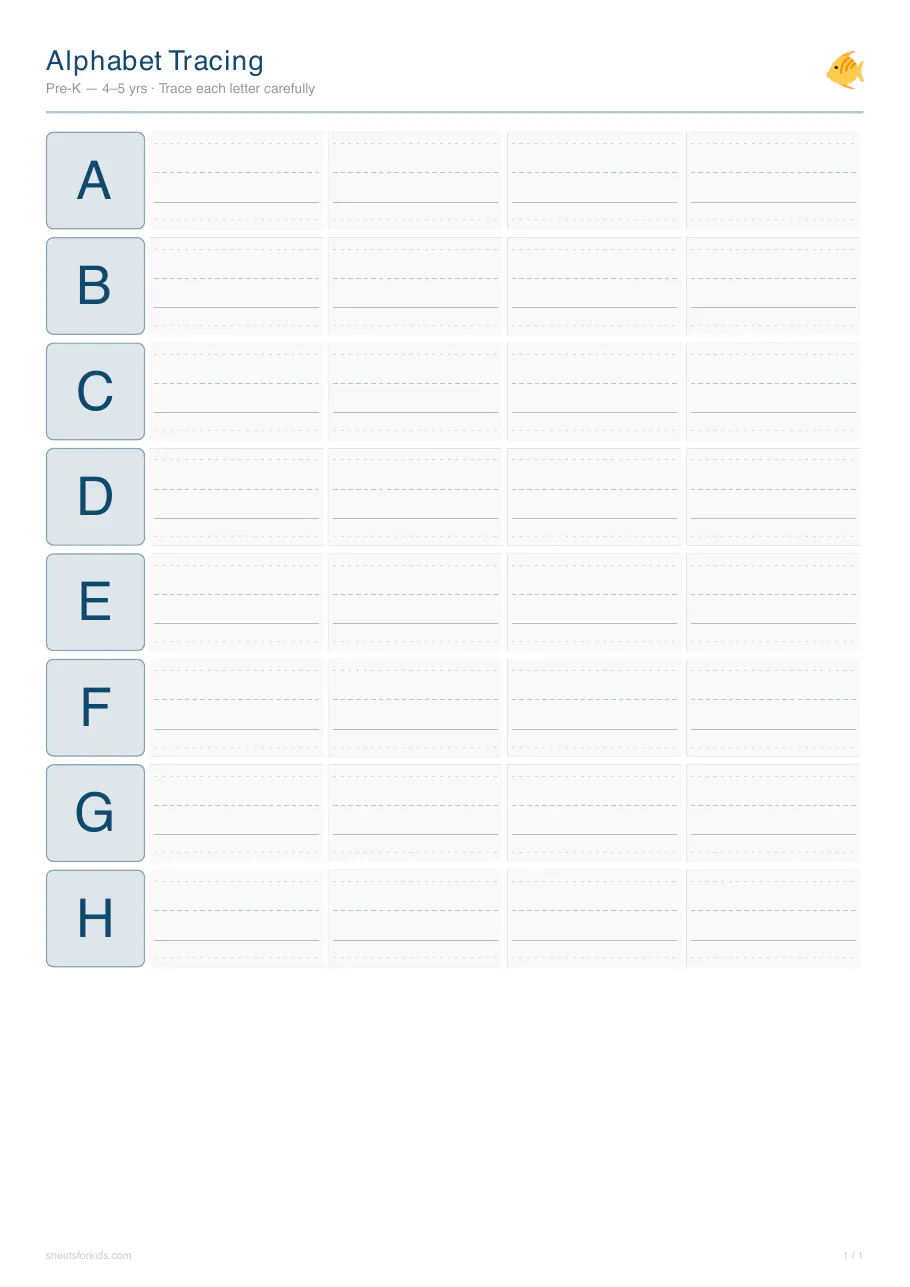
Sample worksheet
Alphabet tracing
Create this worksheetSeptember – December
Full uppercase alphabet
Skills to build
- Trace all uppercase letters A to Z
- Recognize and name each letter
- Count objects up to 10
- Continue simple patterns (circle, square, circle, ...)
- Compare quantities: more, less, same
Recommended worksheets
One click opens the sheet: customize it, then print it as a PDF.
January – March
Introducing lowercase letters
Skills to build
- Trace lowercase letters a, b, c, d, e, f...
- Write name in lowercase with a model
- Count collections up to 10
- Solve simple logic puzzles (easy sudoku)
- Build vocabulary with picture games
Recommended worksheets
One click opens the sheet: customize it, then print it as a PDF.
April – June
Lowercase name & numbers
Skills to build
- Write name in lowercase without model
- Recognize numbers up to 20
- Follow an illustrated weekly planner
- Participate in household chores (tidy up, set the table)
- Understand time: yesterday, today, tomorrow
Recommended worksheets
One click opens the sheet: customize it, then print it as a PDF.
Frequently asked questions
Should my child write in cursive in the second year of preschool?
No. At 4-5 the focus is on printed capital letters, which are simpler to form: the child writes their name in them. Cursive comes later, in the last preschool year, once the hand is steadier.
How high should a child count in the second year of preschool?
Up to about 10. The number sequence is built first by ear (rhymes, games), then by counting small groups of objects. Writing the digits comes later, in the last preschool year.
Does this curriculum match official school programs?
Yes, the term-by-term progression follows the broad outline of the French national curriculum and works as a useful benchmark for families anywhere. You can adapt the pace to your child's needs.
What if my child is ahead of or behind this curriculum?
This guide is a benchmark, not a requirement. If your child moves faster, feel free to check out the next level. If they need more time on a topic, revisit the previous term's worksheets without pressure.
Useful? Share it with other parents